
You’ve just started going to your first beginner pole classes, buzzing from the challenge and proud of what you’re learning. Then you catch sight of your legs in the shower and think, what on earth is happening to my body?
If you’re staring at purple marks on your thighs right now wondering if something went wrong, you’re not alone. Almost every single person who has ever tried pole has had this exact moment. And almost every single one of them nearly talked themselves out of going back because of it.
Here’s what I want you to know. Those marks are not a sign you’re doing something wrong. Also, they’re not a sign your body isn’t cut out for this. These bruises are a normal part of learning a new physical skill that involves gripping and holding onto a metal pole with your bare skin.
By the end of this, you’ll understand exactly why pole bruising happens, why it eases off with time, and why so many pole dancers wear their bruises (we call them pole kisses) with a fair bit of pride instead of hiding them. In fact, many of us get excited when we bruise because it means we learned something new. And that’s an achievement.
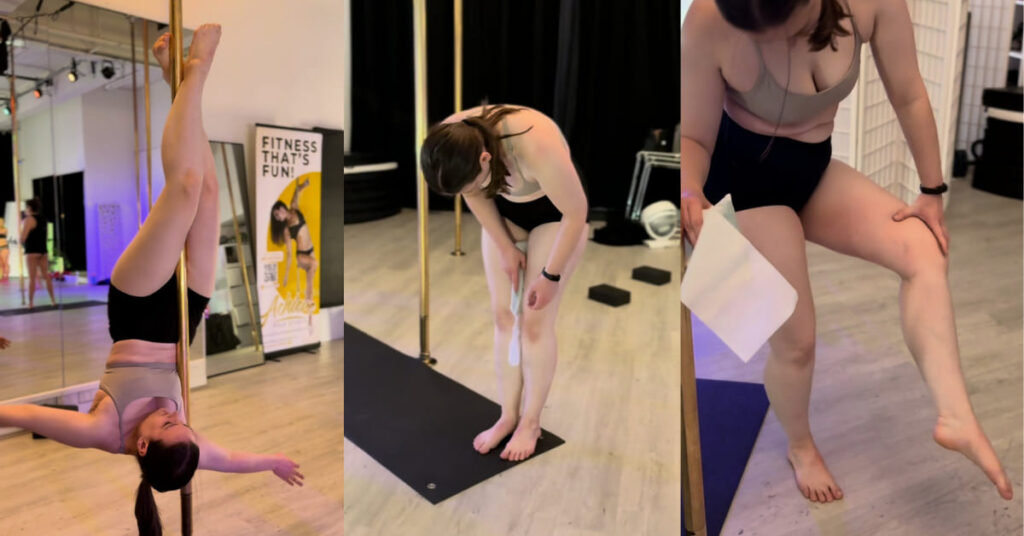
Is This Normal? Why pole bruising is so common for beginners
Pole relies on contact points. Your inner thighs, the backs of your knees, your underarms, your hips. These are places your body has never had to grip and hold weight with before.
When you’re new, you also tend to grip harder than you need to. And this is not a mistake. It’s your body’s natural response to something unfamiliar and a little bit scary. That extra grip means extra pressure on your skin, which is exactly why beginners often bruise more than more experienced students.
Your skin, capillaries and connective tissue simply haven’t adapted to this kind of pressure yet. Give it time and consistency, and they will.
“My bruises were pretty impressive for the first handful of months, and even five years later sometimes I still get them when I’m training hard or learning new moves! Comes with the territory. We call them “pole kisses” … wear them with pride!” – Catie

The grip softens as your confidence grows
This is the part most beginners don’t realise until someone tells them. As you get more comfortable on the pole, you naturally stop gripping so tightly.
You learn where the “sweet spot” is for each move. You learn to trust your body’s positioning instead of white-knuckling everything for dear life. That shift alone is often what makes bruising ease up significantly after the first couple of months.
As your body starts to understand what is going on and what it needs to do, your nervous system learns that it’s safe to hold on a little less hard.
What actually helps while you’re bruising
A few things genuinely make a difference while your body adjusts:
Give bruises time to heal between sessions where you can. Repeating the same skin contact points on fresh bruises can make them worse.
Arnica gel can help bruises heal faster and feel less tender. Just apply it after training, never right before, because it can make your skin slippery on the pole.
Kneepads really help when there’s floorwork involved or you’re doing the choreo classes.
And be patient. This genuinely does get better. It’s one of the most consistent things we hear from long-time pole dancers: the first few months are the hardest on your skin, and then your body catches up.

Why we don’t hide our pole kisses
In the pole community, bruises have a nickname for a reason. We call them “pole kisses” because they’re proof of effort, not something to be embarrassed about. A badge of honor.
Every visible mark tells the story of a new grip you tried, a new move you’re working on, a class where you pushed a little further than last time. Nobody in this community is going to judge you for a bruise on your thigh. If anything, you’ll probably get a knowing nod from someone who has one exactly like it.

This is worth saying clearly: normal training bruises are not the same as pain that doesn’t ease, sharp pain, or an injury. If something feels wrong rather than just tender, that’s always worth mentioning to your instructor. Our team is trained to help you tell the difference and adjust your grip or technique where needed.
“They’re like little badges of honour, even now after 8 months I still get lil bruises” – Jess
What this means for you right now
If you tried your first class and you’re standing in front of the mirror wondering whether pole is really for you because of a few bruises, please don’t let that be the reason you stop.
This happens to almost everyone. The bruising you’re seeing right now is not a sign you’re doing it wrong. It’s a sign you’re doing something brand new with your body, and your body is still catching up. It’s a sign you’re challenging yourself and as they say, growth starts at the end of your comfort zone. So get ready for a stronger, more confident version of yourself!
Give yourself a few more classes. Watch what happens to your grip, your confidence and yes, your skin, as you keep going.
A few key takeaways:
Bruising and grip marks are a normal part of learning pole, especially in the first handful of months. They ease up naturally as your grip technique improves and your body adjusts. Sharp or ongoing pain is different to normal bruising, and it’s always worth flagging to your instructor.
Whether you haven’t tried your first class yet or you’ve already had one and you’re not sure about going back because of a few bruises, the answer is the same: give yourself more than one or two classes. That’s when your grip softens, your confidence builds and you start to see what your body can actually do.
Our 4 Week Beginner Intro Pack gives you the time and consistency to get there. Start here.
Achieve Pole Studio x
Frequently Asked Questions
Are pole dancing bruises normal for beginners?
Yes. Almost everyone bruises when they start pole because your skin and grip technique haven’t adapted yet. It’s one of the most common and expected parts of learning.
Is pole dancing painful for beginners?
There’s some discomfort while your body adjusts to new grip points, but it shouldn’t be sharp or lasting pain. Normal tenderness and bruising ease up within the first couple of months.
How long do pole dancing bruises last?
Individual bruises usually fade within a week or two, similar to any other bruise. The overall amount of bruising you get tends to reduce significantly after your first few months of consistent practice as your skin gets used to it.
What can I do to reduce bruising from pole dancing?
Give your skin time to recover between classes, try arnica gel after training, and focus on relaxing your grip rather than gripping as hard as you can. This naturally improves with practice.
When do pole bruises stop happening?
Most students notice a big drop in bruising after their first two to three months of consistent practice, as their grip technique softens and their skin adjusts. Some bruising can still happen from time to time, even for experienced dancers, especially when learning a new move or training harder than usual. That’s completely normal too.