Somewhere around the ten kilometre mark of City2Surf, your legs stop being the problem.
It’s usually your core that gives out first. Or your form falls apart on Heartbreak Hill and you’re suddenly working twice as hard for the same pace. If you’ve registered for the City2Surf on Sunday 9 August, you’ve probably built a running plan. Long runs, hill repeats, maybe a Saturday park run to test your pace.
What most training plans leave out is everything that happens between your ribs and your hips.
You’ve felt it before. That point in a long run where your lower back starts to ache, your shoulders creep up around your ears, and you’re gritting your teeth just to hold your form. This so often is not about fitness, but rather about stability. And it’s the exact thing a good cross-training habit can fix.
This is where pole comes in, and not in the way you’d expect. By the end of this post, you’ll know exactly what pole training builds in your body and your mindset, and why runners are quietly using it as cross-training before race day.
Your Core Does More Than You Think
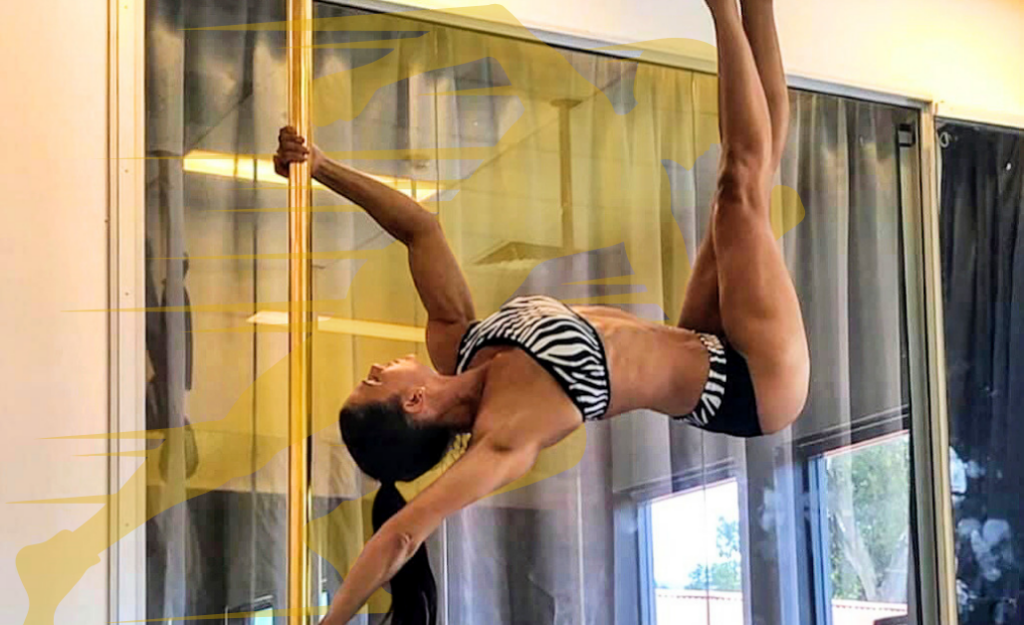
Runners hear “core strength” so often it stops meaning anything. So here’s what it actually does: your core keeps your torso stable while your legs move underneath it, which is the difference between running efficiently and leaking energy with every stride.
Pole is, at its heart, a core and full-body control sport, and the benefits go well beyond what most people expect. Every climb, hold and transition asks your core to stabilise your body while the rest of you moves. Research backs this up too: studies on core training and runners have found it can improve running economy, meaning you use less energy to hold the same pace over a long distance.
That’s the difference between feeling strong at kilometre twelve and feeling like you’re falling apart.
Endurance Isn’t Just Lungs and Legs
Cardio fitness gets all the attention, but muscular endurance matters just as much over 14 kilometres. It’s the ability of your muscles to keep firing correctly, not just for one big effort, but for the full hour or two it takes to get from Hyde Park to Bondi.
Pole classes are full of isometric holds and slow, controlled movements that build exactly this kind of endurance. You’re not sprinting. You’re holding, stabilising and repeating, which trains your muscles to keep working well past the point where they’d normally start to fatigue.
Runners who add this kind of training tend to notice it in the second half of a race, when everyone else is slowing down and their form is still holding.

Body Control You Can’t Get from a Treadmill
A treadmill or a running track moves in one direction. Your body, if you’re being honest, does not always cooperate. Uneven pavement, tired legs, a shift in pace, these all ask your body to adjust in real time.
Pole trains body awareness in a way most cardio simply can’t. You learn to feel where your weight is, correct your position mid-movement and control your body through space, not just push it forward. This kind of proprioception is one of the reasons strength and core work has been linked to real reductions in overuse injuries for runners, the shin splints, tight hips and sore backs that tend to appear around week six of a training plan.
We’ve written before about how this same body awareness supports injury prevention, and it’s just as relevant whether you’re on a pole or on the pavement.
The Mindset Part Nobody Talks About
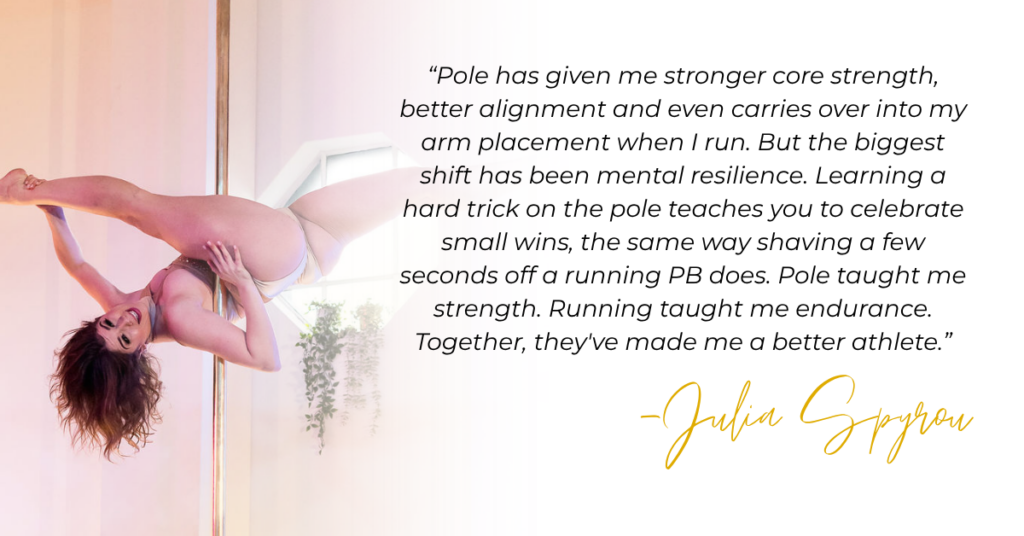
Here’s the part that surprises people most. Pole and endurance running ask the same question of your mind: can you stay calm and keep going when your body wants to stop?
Holding a position on the pole when your grip is burning teaches you to breathe through discomfort instead of panicking at it. That’s the exact skill you need at kilometre eleven, when your legs are heavy and your brain is negotiating with you to walk. Students often tell us they didn’t expect a pole class to change how they handle hard moments elsewhere in life. Runners tend to say the same thing about race day.
Summary
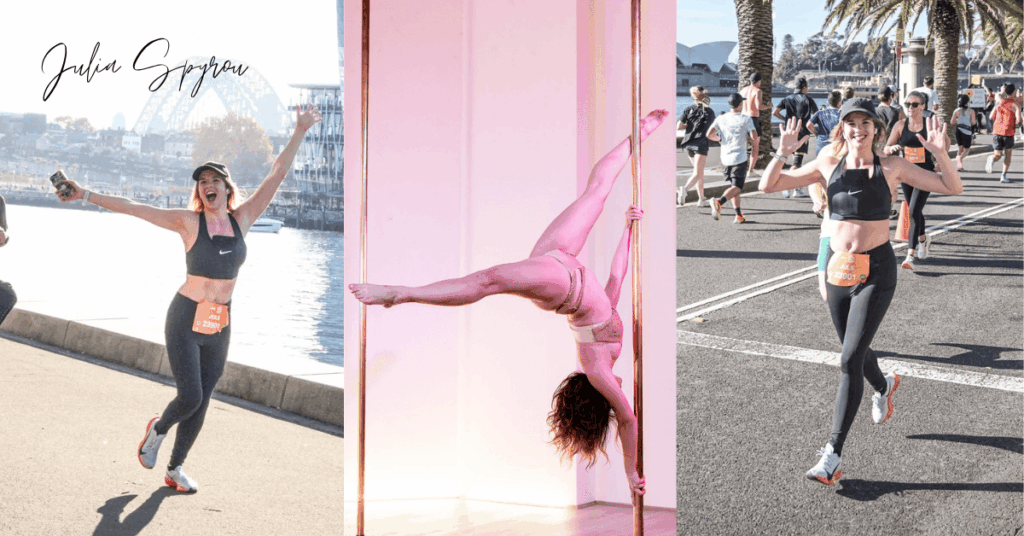
Cross-training for runners isn’t about adding another cardio session to your week. If anything, moving your body differently is exactly the point. It’s about building the core stability, muscular endurance and body control that let your running form hold up when it matters most.
Pole does all three, plus something most training plans forget entirely: it builds your ability to stay steady and keep going when things get uncomfortable. Whether you’re running City2Surf for the first time or the tenth, that combination is worth having in your corner.
We’d love to welcome you before race day, or any day. Book your trial here:
Achieve Pole Studio x
Frequently Asked Questions
Can pole classes actually help with running, or is that a stretch?
It’s a legitimate form of cross-training for runners. Pole builds core stability, muscular endurance and body control, three things that directly support running form and efficiency, especially over longer distances like City2Surf.
I've never done pole before. Will I be able to keep up if I'm not flexible or strong?
Yes. Every class starts with the basics and you build strength and control as you go. Plenty of our students arrive with zero pole experience and plenty of running experience, and the two complement each other more than they expect.
How is pole different to a regular gym cross-training session?
Pole asks your whole body to work together at once, your core, grip, shoulders and legs, rather than isolating one muscle group. It also trains control and body awareness in a way that’s hard to replicate on a machine.
Do I need to be training for City2Surf to benefit from this?
Not at all. City2Surf is a great excuse to start, but the core strength, endurance and mindset benefits apply whether you’re a weekend jogger, a regular runner or just someone who wants to move differently.